
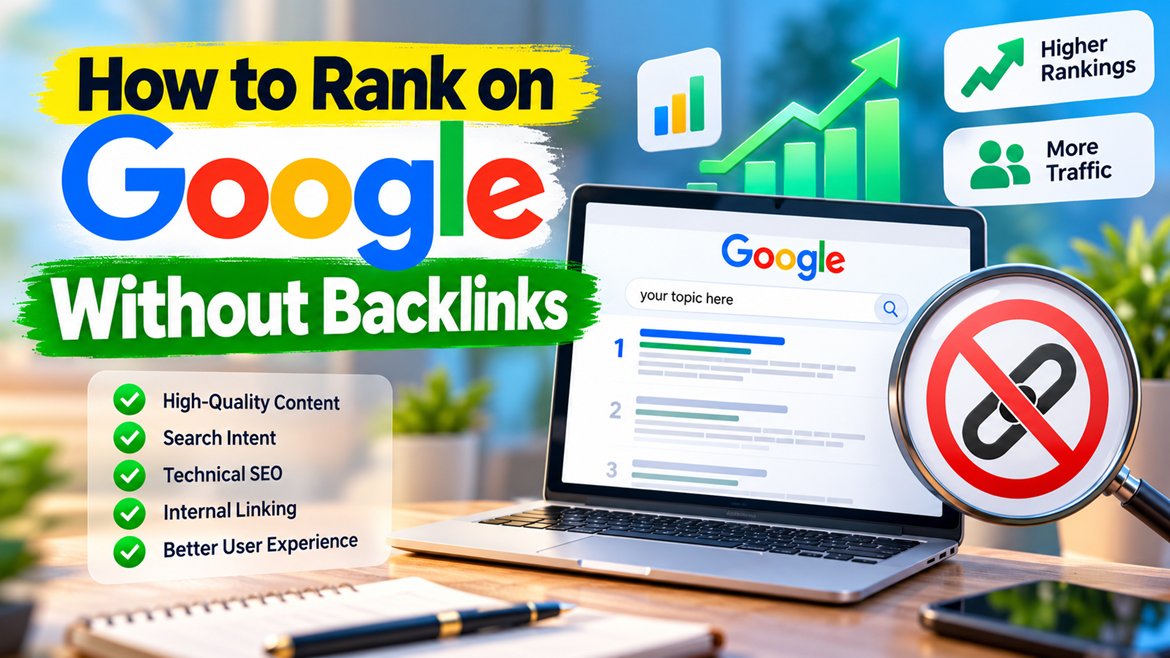
Ranking on Google without actively building back links is possible, particularly when you target specific search queries, create genuinely useful content, and make your website easy for Google to crawl, understand, and index.
However, “without back links” does not mean back links are irrelevant. Google says it primarily discovers pages through links, while its SEO guidance also emphasizes useful, unique, well-organized, people-first content.
For newer or smaller websites, the practical approach is to compete where your content can provide a clear answer or better experience rather than trying to compete immediately for extremely broad, high-authority keywords.
Can You Really Rank Without Back links?
Yes, but there is an important distinction.
You can rank individual pages without deliberately acquiring back links. Google does not require website owners to purchase links or run link-building campaigns before their pages can appear in Search.
At the same time, Google states that it primarily discovers pages through links from pages it has already crawled. This means internal links and natural links can still be important for discovery, even if you never conduct an external back link campaign.
Your chances are generally stronger when you target:
- Specific long-tail searches
- Questions with clear informational intent
- Local or specialized topics
- Undeserved subtopics
- Keywords closely related to your expertise
- Existing pages that already receive impressions but need improvement
The goal is not to “beat Google.” It is to make your page one of the most useful answers available for a particular search.
1. Start With Search Intent, Not Just Keywords
One of the biggest mistakes in SEO is choosing keywords solely because they have search volume.
Instead, ask:
“What does someone actually want when they search this phrase?”
For example, consider:
“best running shoes”
The searcher may want product comparisons, reviews, prices, specifications, or recommendations.
Compare that with:
“how to clean white running shoes”
This search has a much clearer informational purpose.
Match Your Content to the Intent
Before creating a page, examine the search results and identify the dominant format:
- Tutorials
- Product pages
- Comparisons
- Guides
- Definitions
- Videos
- Local businesses
- Lists
- Tools or calculators
Then create something that satisfies that intent more completely.
This is especially useful when you don’t have a large back link profile.
2. Target Long-Tail Keywords
Broad keywords can be extremely competitive.
Instead of targeting:
“SEO”
consider more specific searches such as:
“how to improve SEO for a small business website”
or:
“how to optimize a WordPress blog for local SEO”
Long-tail queries often have narrower intent, allowing a smaller website to focus its expertise on a specific problem.
Build a Keyword Cluster
Don’t create dozens of unrelated articles simply because they have keywords.
Instead, build topical clusters.
For example, a website about SEO could have:
Main topic:
SEO for small businesses
Supporting topics:
- Local SEO basics
- Google Business Profile optimization
- Technical SEO checklist
- Keyword research for local businesses
- Internal linking strategies
- SEO content planning
- Measuring SEO performance
This creates a logical information architecture and gives readers useful pathways between related pages.
3. Create Content That Adds Something Original
Simply rewriting the top 10 Google results is unlikely to produce a genuinely differentiated resource.
Google’s guidance asks creators whether their content provides original information, research, analysis, substantial value, and a complete treatment of the subject.
Add value through:
- First-hand experience
- Original examples
- Screenshots
- Data you’ve collected
- Case studies
- Expert commentary
- Step-by-step processes
- Templates
- Checklists
- Calculators or useful tools
- Lessons learned from real projects
For example, instead of writing another generic article about “keyword research,” document an actual keyword research workflow and show how you evaluate search intent, competition, content gaps, and conversion potential.
That creates a reason for someone to choose your page.
4. Demonstrate E-E-A-T
E-E-A-T stands for:
Experience, Expertise, Authoritativeness, and Trustworthiness.
Google explains that E-E-A-T itself is not a specific ranking factor, but its systems use various signals that help identify content demonstrating these qualities. Trust is described as the most important aspect.
Make Your Expertise Visible
Consider including:
- A clear author name
- Author bio
- Relevant professional experience
- About page
- Editorial policy
- Sources and references
- Original research
- First-hand examples
- Appropriate citations
- Contact information
For topics where accuracy is particularly important, transparent sourcing becomes even more valuable.
Google specifically encourages clear information about who created content and, where appropriate, information about how the content was produced.
5. Optimize Your Title and Headings
Your title should clearly communicate what the page offers.
Instead of:
SEO Tips
try:
How to Improve SEO for a Small Business Website: 15 Practical Steps
Your headings should also create a logical structure.
For example:
H1
How to Rank on Google Without Back links
H2
Can You Rank Without Back links?
H2
How to Find Low-Competition Keywords
H2
How to Create Better Content
H2
Technical SEO Fundamentals
H2
How to Measure Your Results
Don’t force keywords into every heading. Google can understand related terminology and variations without exact-match repetition.
6. Strengthen Your Internal Linking
If you aren’t building external back links, your internal link structure becomes especially important for navigation and helping users discover related resources.
Create logical connections between relevant pages.
For example:
SEO Guide → Keyword Research → Search Intent → Content Optimization → Technical SEO
Use descriptive anchor text that tells readers what they will find.
Avoid creating hundreds of artificial internal links. Every link should have a useful reason to exist.
7. Improve Technical SEO
Excellent content cannot perform properly if Google cannot access or understand the page.
Check the basics:
- Make important pages crawl able
- Avoid accidental no index directives
- Use descriptive URLs
- Create logical navigation
- Make pages mobile-friendly
- Use HTTP
- Fix major broken links
- Improve Core Web Vitals where necessary
- Submit an XML sitemap when appropriate
- Monitor indexing through Google Search Console
Google’s developer guidance specifically recommends checking whether Google bot can access pages and whether robots.text or no index directives are unintentionally preventing indexing.
8. Improve Page Experience
Page experience isn’t simply about making a website “fast.”
Google recommends considering the overall experience, including:
- Core Web Vitals
- Mobile usability
- HTTP
- Intrusive interstitial s
- Excessive advertising
- Clear presentation of the main content
Google emphasizes that site owners shouldn’t focus on only one page-experience factor in isolation.
A useful article that loads quickly, is easy to read, and works properly on mobile is generally a better experience than a cluttered page filled with unnecessary elements.
9. Use Images Strategically
Images can support both users and search visibility.
Use relevant, high-quality images near the content they explain. Google recommends using sharp images and placing them near relevant text.
For better image SEO:
- Use descriptive filenames
- Write useful alt text
- Compress images appropriately
- Use modern image formats where practical
- Avoid decorative images that add no value
- Place images close to related content
Featured Image
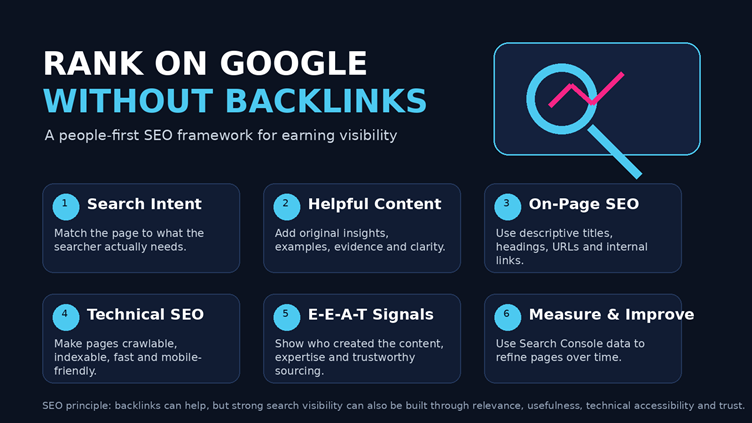
I created a custom PNG info graphic for this article:
Download the high-quality PNG featured image
10. Use Structured Data Where Appropriate
Structured data can help Google understand specific types of content and can make eligible pages qualify for certain enhanced search appearances.
Depending on the page, this could include appropriate structured data for things such as:
- Articles
- Products
- Organizations
- Events
- Breadcrumbs
- Local businesses
Don’t add structured data simply because you think it automatically improves rankings. Use the markup that accurately represents the content on the page.
11. Update Existing Content
Creating new articles isn’t always the best use of your time.
Look at existing pages that:
- Receive impressions but few clicks
- Rank around positions 8–20
- Have declining traffic
- Contain outdated information
- Have weak search-intent alignment
- Are missing important subtopics
Then improve them.
For example, if an article ranks on page two for a relevant keyword, you could:
- Analyze the current search intent.
- Improve the introduction.
- Add missing information.
- Replace outdated examples.
- Improve headings.
- Add relevant internal links.
- Strengthen the title and meta description.
- Improve readability.
- Add original experience or evidence.
- Monitor performance afterward.
Google notes that SEO changes can take anywhere from hours to several months to show an effect, so avoid judging an optimization immediately.
12. Use Google Search Console as Your Feedback Loop
Search Console can show you what is actually happening rather than forcing you to rely on assumptions.
Look for:
- Impressions
- Clicks
- Average position
- Queries
- Pages receiving search traffic
- Indexing issues
Suppose one article begins receiving impressions for 30 related searches.
That’s valuable information.
Those queries can reveal what Google and searchers associate with the page. You can then improve the article around genuinely relevant topics instead of blindly publishing another article.
What You Should Avoid
Trying to rank without back links should not mean replacing link building with manipulation.
Avoid:
- Keyword stuffing
- Hidden text
- Automatically generated low-value pages
- Mass-produced content with little original value
- Scraped content
- Doorway pages
- Purchased links intended to manipulate rankings
- Automated link schemes
- Excessive link exchanges
Google’s spam policies explicitly identify practices such as link spam, keyword stuffing, scaled content abuse, and scraping as problematic.
A Practical 30-Day No-back link SEO Plan
Week 1: Research
- Choose one focused topic.
- Analyze search intent.
- Identify long-tail queries.
- Study competing pages.
- Find information gaps.
Week 2: Create
- Produce a comprehensive article.
- Add original examples.
- Optimize title and headings.
- Add relevant images.
- Add internal links.
- Include trustworthy sources.
Week 3: Technical Optimization
- Check indexing.
- Test mobile usability.
- Review Core Web Vitals.
- Check URLs and cannibalization.
- Verify internal links.
- Submit or inspect important URLs through Search Console.
Week 4: Measure and Improve
Review Search Console data.
Look for pages gaining impressions but receiving limited clicks. Improve their titles, introductions, structure, and content where appropriate.
Then continue the cycle.
Final Thoughts
Ranking on Google without actively building back links is not about discovering a secret SEO trick. It is about concentrating your effort on the factors you can directly control: search intent, useful content, topical relevance, technical accessibility, internal linking, page experience, transparency, and continuous improvement.
Back links remain part of the broader web ecosystem, and Google says links can help it discover pages. But you don’t need to make link acquisition the starting point for every SEO project.
For smaller websites especially, a focused strategy can begin with narrowly defined topics where you can demonstrate genuine expertise and provide information that is more useful than a generic summary.
The most sustainable mindset is simple: create the page you would want to find if you were the person searching—and then make sure Google can understand, access, and discover it.
Also Read
- ► How to Grow Website Traffic by 200% in 3 Months
- ► The Impact of Social Media on Content Distribution
- ► Mastering the Art of SEO: Effective Blogging Techniques for 2026
- ► The Importance of SEO in Content Creation
- ► How to Identify High-Quality Blogs for Guest Posting
- ► Strategy to Build an Email List Using Guest Blogging
- ► Guest Blogging Strategies for Local Businesses
- ► The Role of Visual Content in Guest Posts
- ► The Role of Influencers in Guest Blogging
- ► Guest Blogging Impact in Different Industries
- ► How to Repurpose Guest Posts for Maximum Reach
- ► Guest Blogging Strategies for E-Commerce Sales
- ► Unlocking the Real Power of Backlinks in SEO
- ► The Essential Role of Content in Guest Blogging
- ► Beyond the Backlink: Building Real Relationships Through Guest Blogging

Leave a Reply