

Keyword research is one of the foundations of effective SEO. It helps you understand what people search for, why they search for it, and what type of content can best satisfy their needs.
For beginners, keyword research can initially seem complicated because SEO tools provide hundreds or thousands of potential keywords, along with metrics such as search volume, competition, keyword difficulty, and cost per click.
However, effective keyword research is not simply about finding keywords with the highest search volume. A stronger approach combines relevance, search intent, competition, business value, and the quality of the existing search results.
Google’s own guidance recommends thinking about the words users might search for while creating helpful, reliable, people-first content rather than writing primarily to manipulate rankings.
What Is Keyword Research?
Keyword research is the process of discovering and analyzing the words and phrases people use when searching for information, products, services, or solutions online.
For example, a beginner running a website about SEO might start with:
- SEO
- keyword research
- SEO tools
- on-page SEO
- technical SEO
These are seed keywords. They can then be expanded into more specific searches such as:
- keyword research for beginners
- how to do keyword research
- free keyword research tools
- long-tail keywords for SEO
- keyword research strategy
The objective is to build a useful list of search topics that can be matched to appropriate pages and content.
Why Keyword Research Matters for SEO
Good keyword research helps you make better content decisions before investing time in writing.
It can help you:
- Understand your target audience.
- Discover questions your audience is asking.
- Identify content opportunities.
- Match pages with search intent.
- Organize website content into logical topics.
- Find specific long-tail opportunities.
- Improve existing pages using real search data.
- Measure whether your content is attracting relevant searches.
Google Search Console is particularly useful after your website begins receiving impressions because its Performance report shows queries, clicks, impressions, CTR, and average position.
Step 1: Define Your Audience and SEO Goal
Before opening a keyword research tool, establish who you want to reach and what you want them to accomplish.
For example, imagine you operate a website selling SEO services.
Your audiences might include:
- Small business owners
- Bloggers
- E-commerce businesses
- Marketing agencies
- Startup founders
Your goals could include:
- Generating informational traffic
- Getting service inquiries
- Promoting specific services
- Building topical authority
- Increasing qualified organic leads
This context makes keyword selection much more useful.
A keyword can have substantial search volume but still be a poor target if the people searching it are unlikely to need your product or service.
Step 2: Start With Seed Keywords
Seed keywords are broad terms that describe your main topic, product, or service.
Suppose your website focuses on digital marketing. Potential seed keywords could include:
- SEO
- content marketing
- link building
- keyword research
- local SEO
- technical SEO
Don’t try to find the perfect keyword immediately. Instead, use these terms as starting points for discovering related searches.
You can find keyword ideas using:
- Google Search suggestions
- Related searches
- Google Search Console
- Keyword research platforms
- Competitor pages
- Customer questions
- Reddit and community discussions
- Product or service documentation
- Sales and customer-support conversations
Google specifically recommends anticipating the different words users may use to search for the same subject, while noting that its systems can understand relationships between related queries.
Step 3: Expand Your Keyword List
Once you have seed keywords, expand them into specific topics and variations.
For example, the seed keyword “technical SEO” could produce:
| Keyword | Potential content |
| technical SEO | Beginner guide |
| technical SEO audit | Step-by-step tutorial |
| technical SEO checklist | Checklist |
| technical SEO tools | Tools guide |
| technical SEO for beginners | Educational article |
| How to do a technical SEO audit | Tutorial |
| technical SEO problems | Troubleshooting guide |
At this stage, don’t immediately eliminate keywords based only on search volume.
Build a broad list first, then evaluate it.
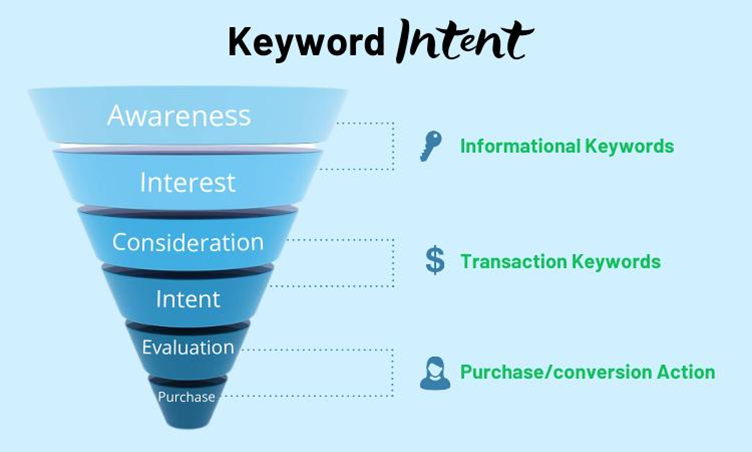
Step 4: Understand Search Intent
Search intent is the reason behind a search.
A useful beginner framework includes four common types.
Informational Intent
The searcher wants information.
Examples:
- What is keyword research?
- How does SEO work?
- What are long-tail keywords?
These searches are generally suited to guides, tutorials, explanations, and educational content.
Navigational Intent
The searcher wants to find a specific website, brand, or page.
Examples:
- Google Search Console
- Ahrefs login
- YouTube
Commercial Investigation
The user is researching options before making a decision.
Examples:
- best SEO tools
- Ahrefs vs Semrush
- best keyword research tools for beginners
Comparison articles, reviews, and buying guides may fit these searches.
Transactional Intent
The searcher is ready to take an action.
Examples:
- buy SEO software
- SEO agency pricing
- hire an SEO consultant
These searches may be better matched to product, service, pricing, or conversion-focused pages.
Step 5: Analyze Search Volume Carefully
Search volume estimates can help you understand relative demand, but volume should not be the only selection criterion.
Consider two hypothetical keywords:
Keyword A: 20,000 searches/month
Keyword B: 500 searches/month
Keyword A sounds more attractive initially. But suppose Keyword A has very broad intent and attracts people who aren’t relevant to your business, while Keyword B is highly specific and closely connected to your service.
The lower-volume keyword may potentially generate more useful visitors.
Therefore, consider:
Relevance + Intent + Competition + Business Value + Search Demand
rather than volume alone.
Step 6: Evaluate the SERF Before Choosing a Keyword
One of the most valuable beginner habits is to actually search the keyword in Google.
Look at the results page and ask:
- What type of pages are ranking?
- Are they guides, product pages, category pages, videos, forums, or tools?
- Does the search result satisfy the apparent intent?
- Are the top results highly authoritative brands?
- Is there an opportunity to create something substantially more useful?
- Would your website realistically be relevant to this query?
This process is often more informative than relying exclusively on a keyword difficulty score.
For example, if the results are dominated by detailed tutorials, creating a thin 500-word promotional page probably won’t match the dominant intent.
Step 7: Find Long-Tail Keywords
Long-tail keywords are usually more specific search phrases.
Examples:
- keyword research
- keyword research for beginners
- free keyword research tools for bloggers
- how to find long-tail keywords for a new website
Specific searches can reveal clearer user needs.
However, don’t assume that every long-tail keyword is automatically easy to rank for. Evaluate the actual search results and your site’s relevance before deciding.
A group of closely related long-tail queries can also help you build comprehensive content around a broader topic.
Step 8: Analyze Keyword Competition
Most SEO tools provide some type of competition or difficulty estimate.
These metrics can be useful for comparing keywords within a tool, but they should not be treated as guarantees of ranking difficulty.
A practical evaluation can include:
- Your website’s topical relevance
- Existing authority
- Content quality
- Search intent
- SERF competition
- Competitor content depth
- Search demand
- Potential business value
For a newer website, targeting highly specific and relevant topics can provide a sensible starting point while you build content depth and authority.
Step 9: Group Keywords Into Topics
Avoid creating a separate page for every tiny keyword variation.
Instead, group closely related searches into keyword clusters.
For example:
Primary topic: Keyword Research
Related terms:
- keyword research strategy
- how to do keyword research
- keyword research for beginners
- keyword research process
- SEO keyword research
These may be addressed naturally within one comprehensive resource if the search intent is substantially similar.
Google’s systems can understand relationships between related search terms, so repeating the same keyword unnaturally throughout an article is unnecessary.
Step 10: Create a Keyword-to-Content Map
Once you have your keyword clusters, map them to specific pages.
Example:
| Keyword cluster | Suggested page |
| keyword research basics | Beginner guide |
| keyword research tools | Tools comparison |
| long-tail keywords | Long-tail keyword guide |
| technical SEO | Technical SEO guide |
| local SEO keywords | Local SEO guide |
| keyword research services | Service page |
This prevents multiple pages from unnecessarily competing for the same search intent.
It also helps create a logical website structure.
Step 11: Use Existing Search Data
If your website already receives Google Search traffic, don’t rely entirely on third-party keyword tools.
Open Google Search Console and review the Queries report.
Look for:
- Queries generating impressions but few clicks
- Relevant queries where your pages already appear
- Queries producing increasing impressions
- Pages ranking for unexpected related terms
- Queries that reveal missing subtopics
Search Console lets you examine queries and pages and compare performance over different periods.
This creates an important feedback loop:
Research → Publish → Measure → Improve → Research again
A Simple Keyword Prioritization Framework
For beginners, create a spreadsheet with columns such as:
| Keyword | Intent | Relevance | Volume | Competition | Content Type | Priority |
| keyword research | Informational | High | High | High | Guide | Review |
| keyword research for beginners | Informational | High | Medium | Medium | Tutorial | High |
| free keyword research tools | Commercial | High | Medium | Medium | Comparison | High |
| SEO keywords for small business | Informational | High | Medium | Medium | Guide | High |
Instead of automatically selecting the highest-volume terms, assess the overall opportunity.
Common Keyword Research Mistakes to Avoid
Choosing Keywords Only Because They Have High Volume
High volume doesn’t automatically mean high-value traffic.
Ignoring Search Intent
A keyword can be relevant to your industry but still require a completely different type of page.
Stuffing Keywords Into Content
Use important terminology naturally. Google’s Search Essentials recommends using words people would use to find your content in relevant locations, but SEO should support helpful content rather than replace it.
Creating One Page for Every Keyword Variation
Closely related searches can often be addressed within a single comprehensive resource.
Ignoring Existing Data
Your own Search Console data can reveal valuable search opportunities that generic keyword research may not uncover.
Writing Only for Search Engines
Google’s current guidance emphasizes helpful, reliable, people-first content and asks creators to demonstrate appropriate experience, expertise, sourcing, and authorship where relevant.
E-E-A-T and Keyword Research
Keyword research should help you decide what users need, not dictate what you write word-for-word.
A strong SEO article should add genuine value through:
- First-hand experience where appropriate
- Accurate information
- Clear authorship
- Reliable sources
- Original examples
- Practical explanations
- Transparent methodology
- Useful supporting resources
Google describes E-E-A-T as experience, expertise, authoritativeness, and trustworthiness, while noting that E-E-A-T itself is not a single ranking factor.
A Beginner-Friendly Keyword Research Workflow
If you’re starting from zero, use this simple process:
1. Define your audience
↓
2. Identify 5–10 seed topics
↓
3. Expand each seed keyword
↓
4. Group related keywords
↓
5. Determine search intent
↓
6. Examine the Google SERF
↓
7. Assess relevance and competition
↓
8. Prioritize realistic opportunities
↓
9. Map keywords to content
↓
10. Publish and measure results
↓
11. Update based on Search Console data
This approach keeps keyword research connected to actual content strategy rather than treating it as a spreadsheet exercise.
Conclusion
A successful keyword research strategy for beginners doesn’t require choosing the keyword with the biggest search volume or collecting thousands of phrases.
The goal is to understand your audience, their search intent, the questions they need answered, and the content that can genuinely satisfy those needs.
Start with relevant seed topics, expand your ideas, analyze search intent, study the SERPs, evaluate competition, group related queries, and map them to useful content. Then use real performance data from Google Search Console to refine your strategy over time.
Also Read
- ► Technical SEO Audit Step-by-Step Guide
- ► How to Rank on Google Without Backlinks: A Practical SEO Guide
- ► How to Grow Website Traffic by 200% in 3 Months
- ► The Impact of Social Media on Content Distribution
- ► Mastering the Art of SEO: Effective Blogging Techniques for 2026
- ► The Importance of SEO in Content Creation
- ► How to Identify High-Quality Blogs for Guest Posting
- ► Strategy to Build an Email List Using Guest Blogging
- ► Guest Blogging Strategies for Local Businesses
- ► The Role of Visual Content in Guest Posts
- ► The Role of Influencers in Guest Blogging
- ► Guest Blogging Impact in Different Industries
- ► How to Repurpose Guest Posts for Maximum Reach
- ► Guest Blogging Strategies for E-Commerce Sales
- ► Unlocking the Real Power of Backlinks in SEO


Leave a Reply